
Issue 54 - The Intern
Let's develop pro tools


Over the last few years, a subject has come up: we don’t hire juniors or interns anymore1. LLM coding agents are the new juniors, they say.
You’ve probably heard the pitch by now. The sales guys and the tech evangelists - they all love to say it:
“AI is like having an army of interns at your disposal.”
But I don’t think we’ve ever had a problem where we thought, “Man, you know what we need right now? An army of interns. Just like, hundreds of people who don’t really know what they’re doing. That would REALLY help.”
The problem isn’t capability or capacity - it’s trust.
How do you trust a junior developer? Over time, through practice and teaching. We forget that trust is a resource you have to build. It’s slow. It’s expensive. It’s exactly like working with a junior developer. You don’t just hand them the keys to production on day one (or at least, I hope you don’t). You teach them. You review their PRs. You watch them break things, fix things, and eventually - slowly - you learn to trust their judgment.
I actually feel more and more the same way working with LLM coding agents for serious work. When it’s not a greenfield project, I cautiously give them the proper scope, take the time to review their work, give them only the easy stuff. The same work I’d give to an intern.
So why are we so convinced we should hire the artificial ones?
I mean, yes, the artificial ones are trained. It’s expensive to train them. Our whole economy could crash because of it. And yes, we trust them - at least to some extent.
Since trust is something you build over time, the more we use these new orbs, the more we’ll trust them. I already feel pretty confident run a Codex Agent, use Cursor for any kind of serious tasks or let my Comet Perplexity agent take control of my browser to move a Google Doc into a Google Slide.
But I still feel the need to train someone. Not just for empathy or self-ego, but to see where I don’t understand things, where I have holes in my reasoning - and ultimately, to pass on a culture.
The instinct with investing in an intern is to curate a culture, not to teach, not primarily.
Because if we don’t hire juniors anymore2, maybe we shouldn’t hire the artificial ones either... those don’t really get on the culture stuff.
The more mature teams have already figured out the new cultural shift: you still hire juniors and interns, but now you teach them to use AI as part of their work. As part of the craft itself. Of the culture we’re building right now. It really feels like we are building from the ground up - not just adding tech here.
Because if nobody teaches new people how to use AI properly, eventually nobody will know how to use it at all.
Let’s not shy away from developing pro tools, but encourage and teach them.
📡 Expected Contents
When natural language feels unnatural
Language is flexible, but flexible does not mean precise. Most people who use LLMs regularly have experienced a variation of the following:
You ask for a small revision, and the assistant rewrites the entire document.
You request a color change in a codebase, and the tool “helpfully” restructures half your components.
You ask for a tighter paragraph, and it returns something in a completely different voice.
The problem isn’t that the model is incapable of understanding the request. The problem is that the interface is too ambiguous for the level of precision the user expects. Language carries nuance, but it also carries room for misinterpretation. The more specific the adjustment, the more unnatural it feels to communicate it through free-form text.
I hope (and I am sure) we will see not only a text box. We actually see the premise: we use /commands or skills more and more. We create graphs of prompts or agents. We speak to the computer.
At first I was expecting new components to appear, new things in the UI itself. But the more I see where we go so far, the more I see it’s more of a multimodal evolution. It resonates a lot with DynamicLand.
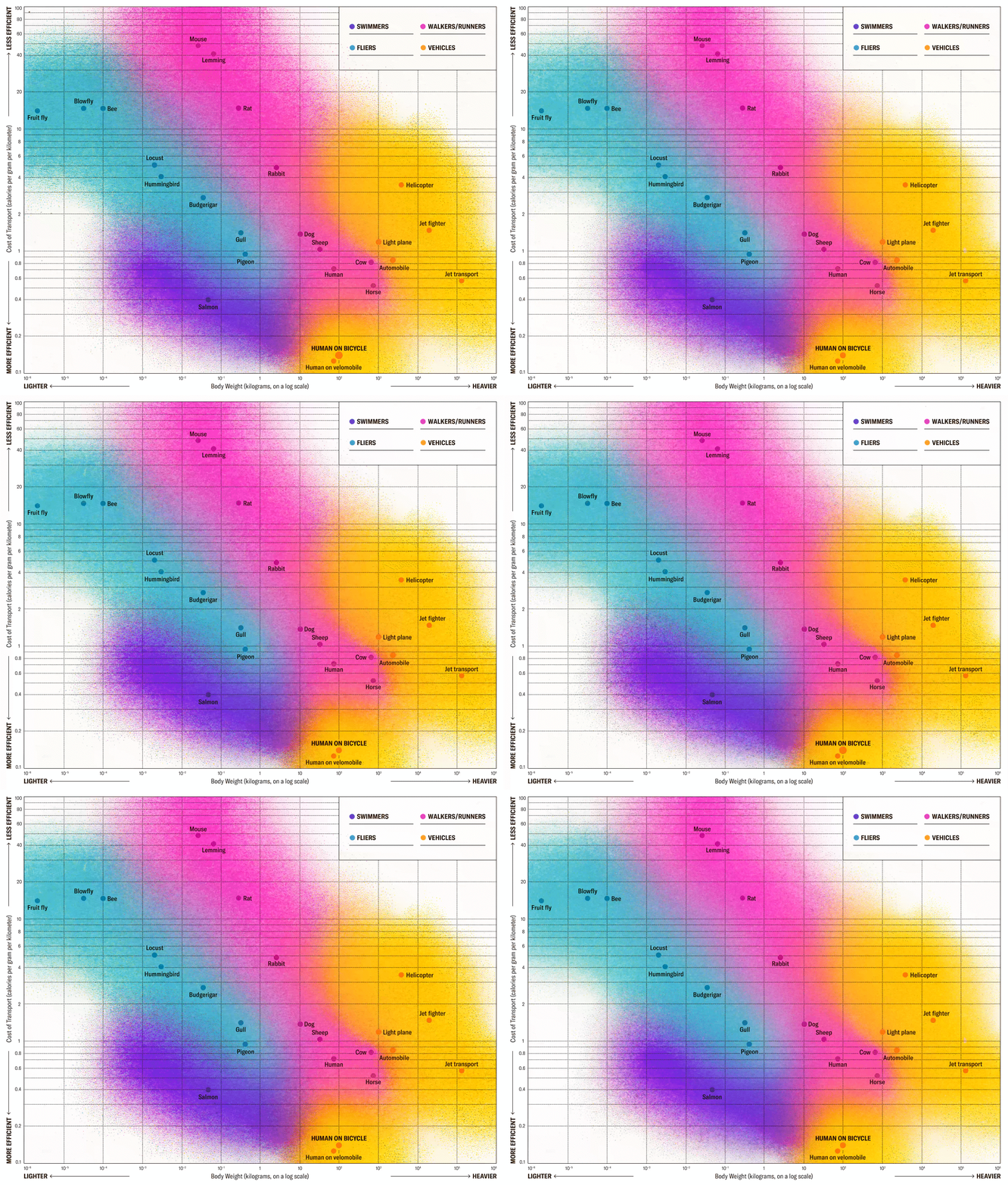
A Human on a Bycicle is Among the Most Efficient Forms of Travel
Bikes allow us terrestrial folk to be more like fish. Wheels, a simple machine, let us coast without putting in power by pedaling, and the rigid frame supports the sitting rider against gravity. “They turn humans into this hyperefficient terrestrial locomotor because they make being on land more like swimming,” says Tyson Hedrick, a comparative physiologist at the University of North Carolina at Chapel Hill. The main drawback is our clunky human shape; bicyclists aren’t streamlined like bluefin tuna, so they must overcome more drag. Hedrick calculates that bicycles with an aerodynamic shell, called velomobiles, can let humans move with even more aquatic efficiency.
Using power tools
Knowing when to use which tool is a mark of maturity. The master woodworker isn’t defined by owning the most powerful equipment but by judgment. They know when to reach for the table saw, when to use a hand plane, and when to stop cutting altogether.

The Programmer Identity Crisis
I think we’re wrong about vibe coding. It’s not a regression from expert developer. And maybe it’s a real win: flow state.
When I vibe code, I’m in flow. I talk to the computer or write energetically. When I am building an agent, and when that agent is working, I start a new one. I stay in the state. I don’t wait for CI or for the machine to build. I keep working and the agents work for me. I stay in flow state.
📰 The Blog Post
No deep dive blog post this time; quite busy recently. I will see what can be put on papers later this month.
🎨 Beyond The Bracket
Before you ask AI another dumb question, watch this:
Lot of things happening here: end of the year, Kestra 1.2 release, moving in a new appartement, planning vacation, etc. It’s great. Designing and introducing Asset in Kestra is exciting. Moving in a new flat is even more.
I’ve been excited over Claude Code and Superwhisper lately. You see it at work when a product teammate successfully merges a PR in C++ for a DuckDB extension. When I skip asking my designer for UI mockups and just build high-fidelity prototypes directly. When I speak to my computer and watch my personal website rebuild itself.
We all know the shift is happening. And like most of you, I’m excited to see where we will land.
See you until next one!
Looking at different sources, it’s actually not totally clear if this fact is backed by proper data. Here are some references: https://ise.org.uk/knowledge/insights/245/what_is_the_state_of_global_early_career_hiring_in_2024/, https://www.ilo.org/resource/article/future-work-how-will-junior-programmers-be-affected, https://papers.ssrn.com/sol3/papers.cfm?abstract_id=5425555
again, according to current thinking